Before organisations decide what comes next, they need to understand what they already have – and whether those investments are delivering everything they could.
For technology leaders, the next step in refining their digital workspace strategy may not be buying another technology. It may be taking a step back, understanding the environment as a whole and identifying where existing investments can do more.
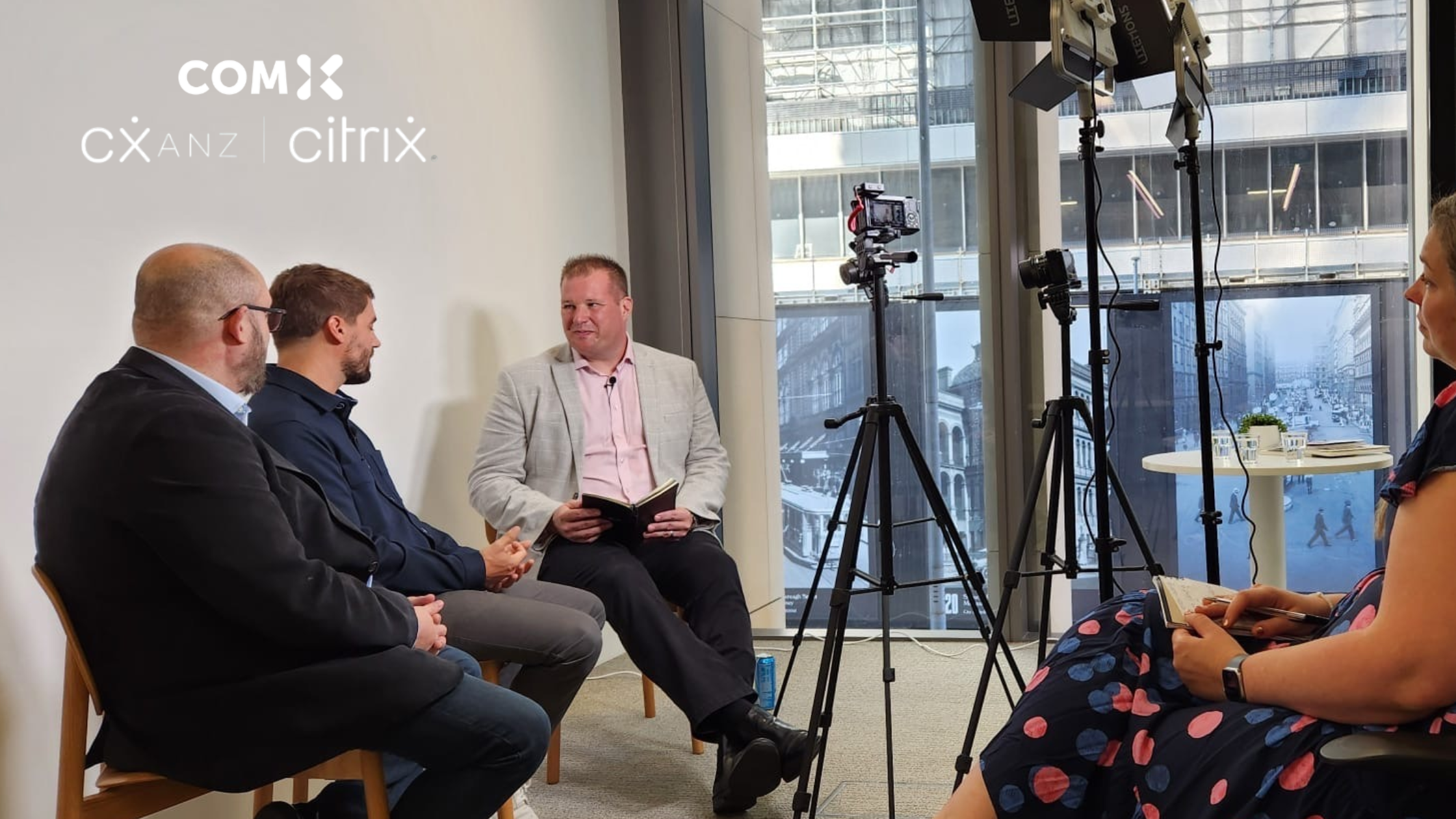
That was a recurring theme in a recent Com-X Connects conversation between Philipp Benkler, VP & GM of Citrix UniconOS, and Wayne Baker, Solutions Architect at CXANZ, hosted by Nick Cross, Director of Sales and Marketing at Com-X.
From endpoint resilience and Citrix consolidation to AI governance and employee experience, the conversation highlighted a broader shift: digital workspace strategy is becoming less about individual technologies and more about how the pieces work together.
An endpoint can also become part of the business continuity strategy
There is another question technology leaders need to consider when thinking about the endpoint: what happens when there is a ‘bad day’?
Cyber incidents and major outages do not simply take applications offline. If the endpoint itself is compromised, employees may have no way of accessing the tools they need to continue working.
“I think it was always ignored: how do I recover my endpoints?” said Philipp.
Citrix UniconOS dual boot is designed to provide an alternative operating environment on the endpoint. If Windows is compromised or unavailable, users can boot into UniconOS and regain access to browser-based and virtualised applications, whilst keeping the Microsoft OS portioned away and available for forensic review.
“On a bad day you press a button, you select UniconOS, and you don't boot into Windows, you boot into a UniconOS experience.”
The objective is to restore productivity quickly while providing an alternative, secure operating environment. “It gets you back in a couple of minutes instead of hours or days,” he added.
Wayne sees this as particularly important when an organisation is dealing with a widespread Windows disruption. “If we've completely lost Windows, we have another outage, we have a worm that goes around and takes out Windows everywhere...we've both lost the backend, now we've lost everybody's client device.”
But if most employees already work primarily through a browser, there is an opportunity to restore productivity quickly. “If we can get back to those SaaS apps, we've got most people back doing most of their functionality inside five minutes,” he added.
The endpoint therefore becomes more than a security consideration. It can become part of the organisation's resilience and recovery strategy.
Simplification starts with using what you already have
For technology leaders, however, adding another capability is not necessarily the answer. Many IT environments are already complex enough. The more important question may be whether existing investments are being fully utilised, or worse fully understood.
Wayne believes organisations should first look at what is already in place and understand how those investments can be used more effectively. That becomes particularly relevant as organisations introduce AI and add more models, applications and services to their environments.
“Of all the AI projects in flight, 59 percent of them use at least two models and 47 percent currently are using three or more,” he said.
Multiple models mean multiple pathways, controls, identities and potential security boundaries.
For organisations already using Citrix NetScaler, Wayne sees an opportunity to consolidate some of that complexity rather than introduce another standalone layer. “NetScaler can simplify that right down and have a single use case device that they already know, in the path towards various different models.”
His broader point is about technology sprawl. “Consolidation around your Citrix estate and looking at how you get the most out of it is probably the right path forward. Because they've already got the skills in-house and having to learn new skills...it's just another piece of the NetScaler technology.”
And that is where simplicity can become more than an IT efficiency. It can become a business advantage.
“The Citrix value stack has become enormous over the last few years...organisations haven't really looked at what else is in that package as well, which could simplify those downstream IT operations,” Wayne added.
For organisations with existing Citrix investments, this creates an important opportunity: before deciding whether to replace, add or move away from technology, understand, with assistance from Com-X, what the current environment can already deliver and where it may be possible to extract more value against your business goals and enhancements to a Microsoft strategy.
AI adoption: move quickly, but don't skip the foundations
AI may be developing at extraordinary speed, but that does not mean organisations should deploy it without controls.
Both speakers pointed to the need for stronger foundations around identity, access, data, security and cost.
Philipp sees AI agents as a new type of user or persona. “So, you need to give them access, permissions. You need to do some control and compliance around them. And I think what was true for humans for a long time will also be true or is becoming true for AI agents in the future.”
That creates a new accountability challenge.
Wayne highlighted the potential role of session recording in understanding what AI agents actually do when they operate computers on behalf of users.
“Being able to prove that back in, say, a CPS 230 type scenario, session recording will give you a complete review of what's actually happened when that agent was doing that on that computer like a regular user.”
The other challenge is financial. AI projects can generate enormous token consumption if they are not properly governed.
Wayne said many AI projects fail not because the technology or use case is fundamentally wrong, but because organisations lose visibility of data and cost.
“The vast majority of them fail. Now, they typically fail not because the technology is bad or the use case is bad. One, they don't have visibility of what's actually gone into the models...and the other one, and probably the biggest one we see, is token spend.”
The result can be a significant gap between the business case and reality.
“They suddenly get the $2 million bill when they think the project is going to cost $200,000.”
Philipp believes token management will become an increasingly important part of AI strategy, including routing different workloads to different models based on their requirements and cost.
“I can do easier tasks. I can ship to a less expensive model than to one that's more expensive. So, I think we'll see lots of development around this area and we're just getting started.”
The message is not to slow down AI adoption. It is to make sure the foundations can support it. That means considering AI alongside the wider digital workspace – including identity, access, applications, endpoints, security and the data moving between them.
Measure what matters: employee experience
So, what should CIOs actually measure?
For Philipp, the answer was employee experience. Rather than relying solely on traditional infrastructure metrics, he pointed to organisations that measure how employees experience their technology.
He described one customer where the key IT measure is Net Promoter Score. “And if it goes down, they have crisis meetings.”
The thinking is simple: if employees can work effectively with the technology provided to them, that experience is ultimately connected to productivity and business outcomes.
For Wayne, that requires organisations to step back from the traditional technology stack and consider the employee experience as a whole. “Most businesses haven't done it,” he said. “It's all become organic. We end up in this world where applications are piled on, agents are piled on, and nobody's really looking at the employee experience as a holistic thing.”
“Now we've got the opportunity to take a little bit of a step back and have a look at that employee experience fully and fundamentally.”
That holistic view is increasingly important because there is no single endpoint, application or platform that defines the modern digital workspace.
Different users have different requirements. Some need Windows applications. Others may work almost entirely through a browser. Some workloads may require additional security controls, while others can be delivered through existing platforms.
The challenge is understanding those requirements and designing the experience around them.
Start with the environment, not the technology
This is where the role of the technology partner becomes increasingly important. Com-X,
Com-X, as a Citrix Preferred Services Partner and the Australian Citrix Partner of the Year, brings value by looking beyond an individual technology and taking a holistic view of the customer's environment.
“It's not just about looking at the Citrix estate or recommending another platform – it's about understanding the organisation's applications, endpoints, security requirements and existing investments, but also the different user personas across the business,” said Wayne. “From there, they can define a digital workspace strategy that reflects how people actually work, rather than forcing a one-size-fits-all approach.”
For both existing Citrix customers and organisations reviewing their options, the starting point should be understanding the current state: how the environment is being used, what the business needs, where the risks and inefficiencies sit, and where existing technology can deliver more value.
It is a shift from technology-led decision-making to outcome-led planning.
The next digital workspace strategy starts with a step back
Perhaps the most important message from the conversation is that CIOs do not necessarily need to start their next strategy by buying something new. They may need to start by understanding what they already have.
That means asking:
• What applications are people actually using?
• Which endpoints genuinely need Windows?
• Where is data moving?
• What security controls are creating friction?
• Which existing platforms can do more?
• Where can AI safely be introduced?
• How should employee experience be measured?
• Are current technology investments aligned with where the business is heading?
For Philipp, the answer starts with putting the employee at the centre. For Wayne, it means making the browser a fundamental part of that experience while recognising that different personas will continue to have different requirements.
The digital workspace is no longer simply about delivering applications to a device.
It is about creating an environment where people, applications, endpoints, data, security and increasingly AI can work together without unnecessary complexity.
For CIOs, the opportunity over the next 12 to 24 months may therefore be less about predicting exactly what the workplace will look like in five years – and more about building a flexible foundation that can adapt as it changes.
That requires technology that works together, investments that can deliver more value over time, and partners who can connect technology decisions to the outcomes the business actually cares about.
As the conversation demonstrated, the future of the digital workspace is not one technology in isolation. It is the experience created when everything works together.
Want to hear the conversation in full? Watch the Com-X Connects interview or listen to the podcast to hear Philipp Benkler and Wayne Baker explore the future of the digital workspace, endpoint strategy, AI and more.
Ready to rethink your digital workspace?
Your endpoint strategy, security model, applications and AI initiatives shouldn't operate as separate projects. The opportunity is to understand your current environment, identify where existing investments can deliver more value, and define a digital workspace that is aligned to your people, technology and business objectives.
Talk to Com-X and discover how your existing technology can support the next stage of your digital workspace strategy.